When to replace spreadsheets with custom software.
Every growing business runs on spreadsheets — until the spreadsheets start running the business. The five warning signs it's time to build a proper web app, and what it actually costs.
Spreadsheets are the world's most successful business software, and for good reason: they're free, flexible, and everyone knows them. Every business we've ever worked with runs on them somewhere. The problem isn't spreadsheets — it's the moment the spreadsheet stops being a tool and becomes infrastructure.
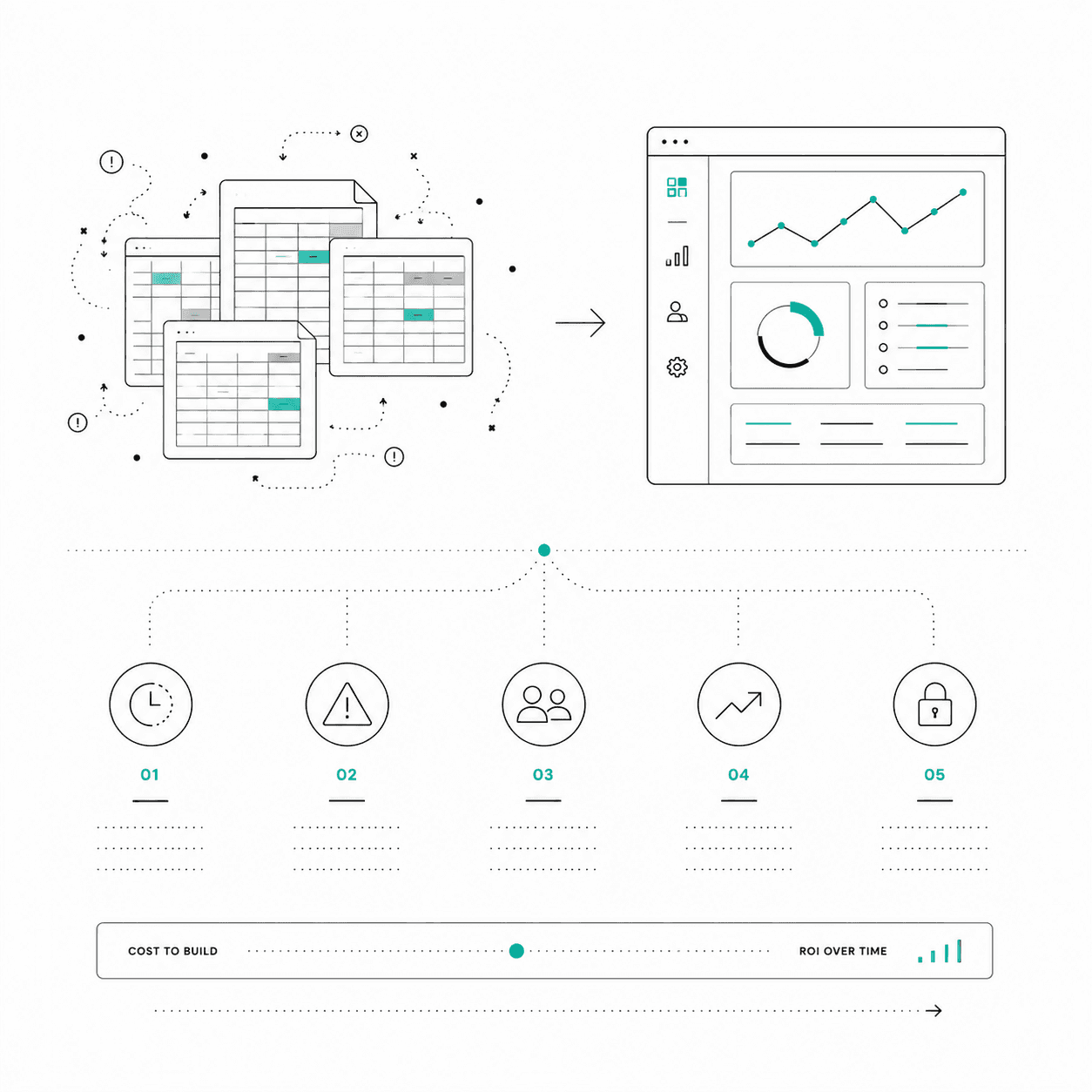
The five warning signs
1. One file has become load-bearing
There's a workbook somewhere in your business that, if deleted tomorrow, would stop operations. It has fifteen tabs, colour-coding only one employee understands, and formulas nobody dares touch. That file isn't a spreadsheet anymore — it's an unmaintained application with no backups, no access control, and no error handling.
2. Copy-paste is a job description
When someone's actual daily work includes moving rows from one sheet to another, re-typing data from emails, or "updating the master file," you are paying a salary for something a system should do in milliseconds — and introducing human error at every step.
3. Nobody trusts the numbers
Two versions of the same file circulate. The total in the report doesn't match the total in the sheet. Meetings start with fifteen minutes of reconciling whose copy is right. Version chaos is the natural end state of shared spreadsheets — it's not a discipline problem, it's an architecture problem.
4. The spreadsheet can't say no
Spreadsheets accept anything: a phone number in the date column, a negative quantity, a booking for a property that's already booked. Real systems validate. When we built Alfanest's booking platform, the single biggest operational win wasn't a feature — it was that double-bookings became structurally impossible.
5. Growth makes it worse, not better
A process that works at 50 rows collapses at 5,000. If every new customer, student, or property adds manual work somewhere, your operations scale linearly with headcount — which means your margins shrink as you grow. Software inverts that curve.
What replacing it actually looks like
It rarely means "rebuild everything." The right first project is almost always narrow: take the single most painful workflow — enrolment, booking, field reports, portfolio tracking — and turn it into a small web app with a database, user accounts, validation, and automation. One workflow, done properly, usually pays for itself before you extend it.
- A shared database instead of duplicated files — one source of truth.
- Roles and permissions instead of "please don't edit this tab."
- Automatic calculations, reports, and exports instead of manual assembly.
- An audit trail: who changed what, when.
The spreadsheet era of a business is nothing to be embarrassed about — it's how every operation figures out what its processes actually are. But once the process is proven, the tool should graduate. If any of the five signs above sound familiar, it's time to scope what a proper system would look like.