The anatomy of a high-converting lead funnel.
A lead funnel is not a landing page with a form. Here's the full anatomy we use — capture, qualification, nurture, and handoff — drawn from funnels that have captured 5,000+ leads.
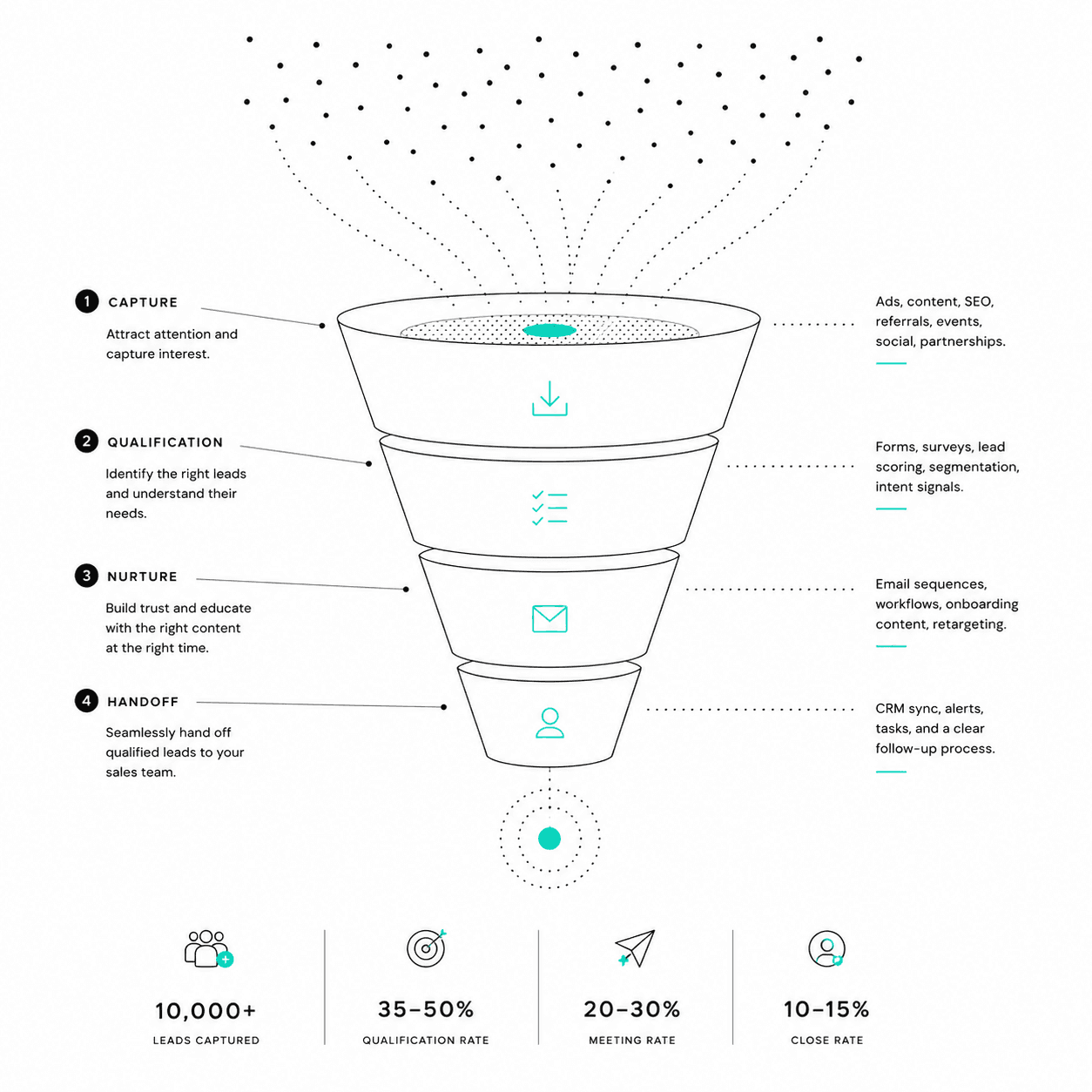
"We need a funnel" usually means "we built a landing page with a form and nothing happened." A landing page is not a funnel. A funnel is a system — and after building funnel ecosystems that have captured more than 5,000 leads across dozens of pages, we can map its anatomy precisely.
Stage 1: The promise (capture)
Cold traffic doesn't want your product yet — it wants relief from a problem. The capture page makes one specific promise to one specific audience: a checklist, a quote, an assessment, early access. Specificity is the whole game. "Download our brochure" converts nobody; "See what your project would cost" converts strangers.
One page, one promise, one field if you can manage it. Every element that isn't advancing the promise — navigation, footer links, secondary offers — comes off.
Stage 2: The qualification (sorting)
This is the stage most funnels skip, and it's where the economics change. A short quiz-style flow — three to five questions about budget, timeline, and situation — does two jobs at once: it makes the lead feel understood, and it sorts your pipeline before a human ever looks at it. Hot leads route straight to a booking calendar. Everyone else enters nurture. Your team stops wasting hours on prospects who were never going to buy.
Stage 3: The nurture (automation)
Most leads aren't ready this week. That's not failure — that's normal. The nurture sequence is an automated email series that delivers genuine value tied to the original promise: answers to the questions they actually have, proof from clients like them, and a standing invitation back to the calendar. For one client, this automation alone reduced manual outreach by over 70%.
- Email 1 — deliver the promised asset immediately, while trust is highest.
- Emails 2–4 — answer the three objections every buyer in your market has.
- Email 5 — a case study that mirrors the lead's situation.
- Ongoing — a steady rhythm of useful content, never noise.
Stage 4: The handoff (CRM)
Every action a lead takes — pages visited, quiz answers, emails opened — should land in your CRM automatically. When someone finally books the call, whoever answers it sees the full story and picks up the conversation mid-thought instead of starting cold. This is also where you measure everything: cost per lead, quiz completion, booking rate, close rate. A funnel without instrumentation is a guess.
Why funnels fail
Nine times out of ten it's one of these: the promise is vague, the qualification is missing so sales drowns in junk leads, the nurture doesn't exist so 90% of captured leads go cold, or nothing is measured so nothing improves. The mechanics aren't complicated — they're just rarely all built.
Build all four stages and the funnel stops being a marketing expense and becomes an asset: a system that turns attention into pipeline on autopilot, every day, without anyone touching it.