Automating client onboarding with CRM workflows.
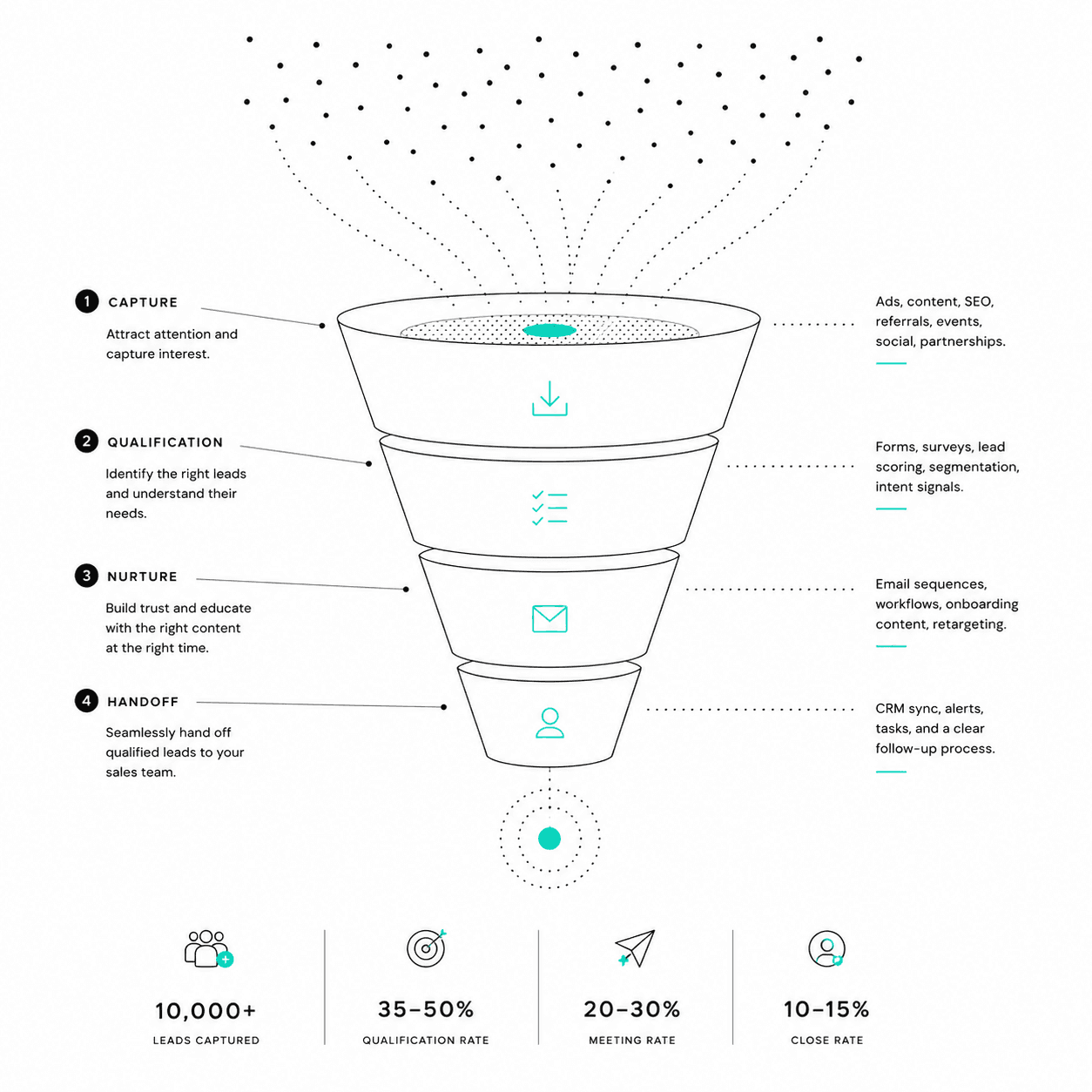
Every client we onboard flows through the same automated pipeline — proposal, contract, kickoff — without anything falling through the cracks. Here's the exact system, step by step.
The most dangerous moment in a client relationship is right after they say yes. Enthusiasm is high, and every manual step between the yes and the kickoff — the proposal you'll send "tonight," the contract, the invoice, the intake questions — is a place where momentum dies and doubt creeps in. We automated our own onboarding end to end (it's the system behind Carasant Systems), and it's the highest-ROI build we've ever done for ourselves. Here's the exact pipeline.
Stage 1: Inquiry → qualified lead
Every inquiry — website form, referral email, booked call — lands in the CRM automatically with its source attached. No lead lives in an inbox. Before the discovery call, an automated sequence sends a short intake form (project type, timeline, budget band), so the call starts at the real conversation instead of twenty minutes of basics.
Stage 2: Call → proposal
The discovery call has one output: enough clarity to scope. Proposals are assembled from a structured template — scope, timeline, price, terms — so producing one takes an hour, not an evening, and every proposal meets a consistent standard. The moment it's sent, the CRM starts a follow-up clock; if there's no response in three days, a polite nudge goes out automatically. Deals stop dying of silence.
Stage 3: Yes → kickoff, untouched by hand
Acceptance triggers the chain that used to be a week of admin:
- Contract generated and sent for e-signature.
- Signature triggers the deposit invoice.
- Payment confirmation creates the project workspace and shared folder.
- The client receives a welcome pack: process, contacts, what happens next, and a kickoff scheduling link.
- The kickoff booking notifies the team with the full history attached.
Elapsed human effort: minutes. Elapsed client experience: "they had the contract before I finished my coffee." That speed is not just efficiency — it's the first proof the client gets that hiring you was the right call.
Stage 4: The relationship memory
Every email, call note, decision, and file lives on the client record. Six months later, when they come back for phase two, nobody asks them to repeat themselves. That continuity is what turns one-off projects into long-term partnerships — and it's a systems property, not a personality trait.
Building this for yourself
- Map your current onboarding as a list of every step between "yes" and "kickoff."
- Mark which steps require human judgment. Automate everything unmarked.
- Start with the follow-up automation — unanswered proposals are the cheapest revenue you'll ever recover.
- Instrument the pipeline: where do deals stall? That stage is your next fix.
Tools matter less than the map — we build these systems on whatever stack fits the client, from Go High Level to fully custom. What matters is that the pipeline exists, runs itself, and never drops the ball you just worked so hard to catch.